Are Cats Liquid? The Physics of Ultimate Flexibility
Summary
- No, cats are not true liquids: Scientifically, cats are solids. However, they exhibit liquid-like properties by conforming perfectly to the shape of any container, a concept formalized in the field of rheology that earned the Ig Nobel Prize.
- Anatomy is the secret: Their extreme flexibility is due to specialized feline anatomy, including a highly pliable spine with numerous vertebrae and a free-floating clavicle (collarbone) that allows them to compress their shoulders and squeeze through tight spaces.
- Body size awareness is selective: Péter Pongrácz’s research found that cats rely on a trial-and-error method when judging width (lateral flexibility), but they show significant hesitation and better self-awareness when negotiating short (vertical) openings.
Table of Contents
You’ve scrolled through the feed. You’ve definitely seen the viral sensations on YouTube and Facebook showing felines defying the laws of physics.
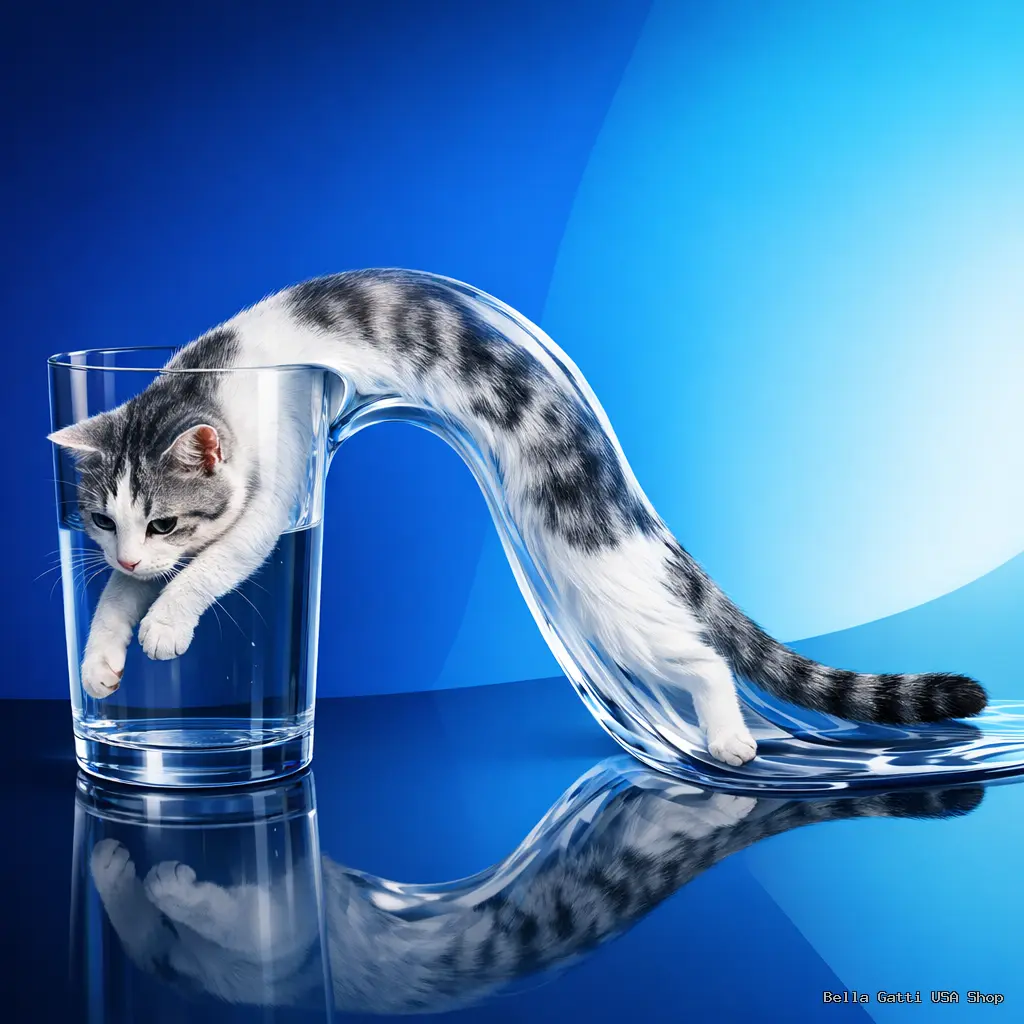
One moment, a cat is pouring itself out of a tiny vase. The next, it’s oozing under a barely-open door jamb. It truly looks like we are dealing with genuine liquid cats.
This playful inquiry, “Wait, cats are liquids?”, has become more than just an internet meme. It has transformed into a serious, yet wonderfully humorous, subject of scientific inquiry.
The short answer involves physics, specialized feline anatomy, and a deep dive into the remarkable feline mind. We need to explore their impressive Cat cognitive abilities.
We are here to explore the science behind that ultimate flexible cat body. Specifically, we will examine the groundbreaking Péter Pongrácz research conducted in Budapest, Hungary, concerning the unique Body size awareness of our favorite malleable felines.
This research helps us understand why your cat seems to possess the ultimate liquid state and how their Cat behavior study reveals surprising self awareness in cats.
The Physics of Feline Fluidity
Let’s get scientific. To truly determine if Cats are liquids, we must first revisit the definition of the classic States of Matter.
A liquid, by definition, flows freely and adopts the exact shape of its container. A solid, conversely, holds a fixed shape and volume.
Technically speaking, your furry friend is composed of bones, muscles, and that signature soft cotton fur, making them structurally a solid.
However, their incredible feline anatomy and ability to conform to any space makes them exhibit properties that are undeniably liquid-like.
The Ig Nobel Prize Connection
The concept of Liquid Cats was not just a viral meme; it was formalized by physicist Marc-Antoine Fardin.
His groundbreaking work on the rheology of felines earned him the prestigious Ig Nobel Prize in Physics in 2017.
The Ig Nobel Prize is specifically designed to honor research that “first makes people laugh, and then makes them think.” Fardin nailed it.
Rheology is the specific field that studies how matter flows, whether it’s a true liquid or a highly flexible solid.
Fardin’s key insight focused on “relaxation time” (the duration required for the material to adapt fully to the container or stress).
His conclusion? If you allow a cat enough time to settle into any given container (be it a box, a sink, or a vase), they will adapt perfectly. They transform into truly malleable felines.
A liquid adapts its shape to fit a container. Cats are thus liquid if we give them the time to become liquid. The state of a material is not really a fixed property.
Beyond Rheology: Body Size Awareness
While Fardin proved that cats can behave as fluids over time, the question shifts: Do cats actually possess inherent Body size awareness?
This is where the field of Animal Ethology steps in, specifically addressing Cat behavior study.
Understanding if a cat knows its own dimensions is crucial when considering how easily they perform those gravity-defying feats of Cats squeezing through tight spots.
Feline Anatomy: Why Cats Ooze and Flow
The true secret behind why cats are liquids (or appear to be) lies deep within Feline anatomy. These creatures evolved as specialized ambush predators, meaning they needed the ability to fit into impossibly small spaces to hunt, hide, or simply nap.
Their bodies are masterpieces of engineering designed for maximum flexibility, allowing for the astonishing sight of cats pouring themselves into tiny receptacles.
The Flexible Cat Spine: A Malleable Feline Masterpiece
The feline spine is the critical component in achieving this fluid appearance. Cats possess significantly more vertebrae than humans, often around 30, excluding the tail.
These bones are shorter, lighter, and connected by exceptionally elastic discs and powerful muscles.
This structure allows for incredible twisting and bending along multiple axes, enabling the famous “cat-righting reflex.” This elasticity is why you see liquid cats gracefully navigating tight spots.
The Floating Clavicle: Mastering the Art of Cats Squeezing Through
Unlike us, who rely on a rigid collarbone (clavicle) connecting the shoulders to the rest of the skeleton, a cat’s clavicle is tiny and free-floating.
This lack of a fixed connection means their shoulders can move independently and slide inward, allowing them to compress their chest dramatically.
The golden rule for cats squeezing through tight spots is famous: If the head fits, the flexible cat body will follow. The skull is generally the widest part of their skeletal structure.
Body Size Awareness: Do Cats Know They Are Liquid?
This astonishing anatomical flexibility leads to a fascinating question related to Feline Behavior and Cat cognitive abilities: Do cats possess accurate Body size awareness?
Research conducted by Péter Pongrácz at Eötvös Loránd University in Budapest, Hungary, explored exactly this. These cat experiments tested whether cats made an *a priori* decision about whether they could fit through a gap without resorting to the *trial-and-error method*.
The study, often cited in Animal ethology circles, showed that cats generally assess the aperture width accurately. They are masters of their own Cat dimensions, demonstrating high Cat intelligence when faced with a small opening.
In short, the ability of cats oozing themselves into containers isn’t just a trick of physics; it’s a brilliant display of Feline Behavior combined with evolutionary anatomical design. That’s why we love these incredible, sometimes liquid cats!
The Feline Mind: Do Liquid Cats Have Body Size Awareness?
While the incredible physical flexibility and specialized Feline anatomy explain the physics of the “Are cats are liquids?” phenomenon, the deeper scientific question is psychological.
Do these seemingly malleable felines actually possess Body size awareness?
To answer this, we turn to a fascinating Cat behavior study conducted by the renowned ethologist, Péter Pongrácz.
Pongrácz, who works at the prestigious Eötvös Loránd University in Budapest, Hungary, has dedicated years to understanding the mysterious Feline mind.
The Rectangular Opening Test: Testing Cats and Their Cat Cognitive Abilities
Pongrácz and his team set up rigorous Cat experiments to test their spatial reasoning, specifically focusing on how they negotiate openings.
They used adjustable openings: some narrow (testing aperture width) and some short (testing height).
This research provided a key comparison point: previous studies showed a difference in Dogs vs cats awareness. Dogs typically hesitate when an opening is too tight, demonstrating clear judgment of their Animal body size.
The feline subjects, including famous participants Iggy and Spud, were observed as they approached the varying dimensions.
Trial-and-Error: The Verdict on Self Awareness in Cats
The results, published in the journal iScience (an Elsevier Inc. publication), provided deep insights into Cat cognitive abilities.
When faced with a narrow gap that challenged the aperture width, Cat hesitation was rare. They overwhelmingly preferred a Trial-and-Error Method.
These liquid cats would approach, try to squeeze, and only retreat if they failed. They did not appear to make “A Priori Decisions” (judgments based on self-representation) when negotiating the width.
However, the findings changed dramatically when the opening was short, forcing the cat to flatten its body vertically.
When the opening was uncomfortably short, the cats slowed down significantly before reaching it. This suggests a reliance on Self awareness in cats when the vertical dimension is challenged.
In short: Cats are better at judging height than width, relying on their incredible lateral Feline Flexibility to handle tight squeezes without much thought. They truly are masters of Cats squeezing through!
The States of Matter: Testing Cats as Fluids (Péter Pongrácz Research)
You know the score: cats defy basic physics. While the previous section explored the psychological side (the mysterious lack of strong Body Size Awareness in the Feline mind), the real fun comes when we compare your cat to the basic States of Matter.
The core concept of “Are cats liquids?” was scientifically explored by researchers like Péter Pongrácz (Eötvös Loránd University, Budapest, Hungary) and Ivan Khvatov (Moscow Institute of Psychoanalysis). Their fascinating work, which earned them the prestigious Ig Nobel Prize, confirmed that while cats are not truly cats as fluids, their physical properties mimic them remarkably well.
This comprehensive Cat behavior study involved rigorous Testing cats against the criteria for true liquids and typical solids. The results highlight the unique nature of the highly Flexible cat body.
Feline Flexibility vs. Physical Properties Comparison
Here is a comparison of how the unique Feline anatomy and locomotory strategy relate to the physical states of matter, demonstrating why we call them Malleable felines.
| Property |
True Liquid |
Solid (Typical Mammal) |
Feline Flexibility (The Liquid Cat Paradox) |
| Conforms to Container |
Yes, completely. |
No, retains shape. |
Yes, given time. This is the phenomenon of Cats pouring or Cats oozing. |
| Fixed Volume |
Yes. |
Yes. |
Yes, volume is constant (A cat cannot compress itself like a gas). |
| Body Size Awareness (Width) |
N/A |
High (e.g., dogs, who use an A Priori Decision). |
Low. Often relies on the Trial-and-Error Method when facing a tight aperture width. |
| Mechanism of Flow |
Molecular movement. |
Rigid structure/skeletal framework. |
Highly Flexible cat body, free-floating clavicle, and specialized Feline anatomy. |
This table clearly shows why the term Liquid cats is so popular. They are essentially a highly adaptable solid, bridging the gap between solid rigidity and fluid adaptability through specialized Feline Flexibility.
The Rectangular Opening Test: Measuring Cat Hesitation
To quantify the difference between a dog’s strong Body Size Awareness and a cat’s approach, the Péter Pongrácz research focused on specific measurement criteria for Testing cats.
The researchers utilized the Rectangular opening test. They meticulously measured whether cats exhibited significant Cat hesitation (a sign of calculating the gap) before attempting to squeeze through various Aperture width dimensions. This provided crucial data for Animal ethology.
The results, published in the journal iScience (Elsevier Inc.), showed that while some cats displayed calculation, many relied on simply attempting the squeeze, the classic Trial-and-Error Method. This difference in Locomotory Strategy is a key reason why we see so many viral videos on YouTube and Facebook showing Cats squeezing through impossible gaps.
This research confirms the delightful truth: your cat might not be a true liquid, but their physical structure and unique Feline Behavior allow them to act like one whenever a cozy box or a tight spot calls their name.
Embracing the Liquid Cat Meme: From Science to Slogan
Whether they are cats oozing out of a laundry basket or simply conforming to the shape of a tiny box, our feline friends continue to baffle us. This isn’t just random luck; the pioneering Péter Pongrácz research suggests their mysterious lack of strong Body size awareness contributes heavily to these seemingly impossible feats.
The result is a perfect demonstration of Feline Flexibility, combining sophisticated hunting strategies with a physical structure built for extreme malleability. This fascinating branch of Animal ethology helps explain why our liquid cats appear to ignore the laws of physics entirely.
The next time you spot a viral video on Google or YouTube showing a cat folding itself into an impossible container, remember the rigorous study that earned this phenomenon the humorous Ig Nobel Prize. It is a perfect blend of laugh-out-loud humor and serious Comparative Psychology.
If you appreciate the absurdity of Cats as fluids, you need to check out our collection of witty graphic tees. Celebrate the ultimate Liquid cats aesthetic with designs that capture this incredible Feline Behavior. We promise our softest, most comfortable Unisex Soft Cotton Tee designs will fit you perfectly, no squeezing or oozing required!
The Physics of Purrs: Liquid Cat FAQs
Are cats technically classified as a liquid?
No, scientifically, cats are biologically solids, consisting of bones, muscles, and organs. They are not true Cats as fluids.
However, the concept is so compelling that physicist Marc-Antoine Fardin won the prestigious Ig Nobel Prize for applying rheology, the study of how matter flows, to the topic. He showed that cats exhibit liquid-like properties by conforming perfectly to a container’s shape, provided they have enough time to ooze. So, while they aren’t technically Cats are liquids, they certainly act like it!
What makes cats so flexible that they appear to be flowing?
It’s all thanks to their incredible Feline anatomy. Unlike humans, they have a free-floating clavicle (collarbone) that allows their shoulders to compress laterally. Combine this with a spine containing numerous, highly flexible vertebrae, and you get a truly Flexible cat body.
This anatomical marvel is the key to Cats squeezing through openings that are only as wide as their head. They are truly Malleable felines.
Did Péter Pongrácz research prove that cats have Body Size Awareness?
The groundbreaking Péter Pongrácz research, conducted at Eötvös Loránd University in Budapest, Hungary, found that cats use Body size awareness selectively. This Cat behavior study offered fascinating insights into the Feline mind.
In their Cat experiments, the researchers found that cats tend to rely on the Trial-and-Error Method when judging width (lateral flexibility or Aperture width). However, they show significant Cat hesitation and awareness when negotiating short openings (vertical height).
This suggests that while they might just try to squeeze through tight spaces laterally, their Cat cognitive abilities prioritize spatial awareness when dealing with height.
Why do cats seem to enjoy fitting into small containers?
This behavior is deeply rooted in their natural instinct and Feline Behavior. Small, enclosed spaces offer security, warmth, and protection, mimicking the safe dens or hiding spots used by wild felines.
This innate desire for security reinforces the viral aesthetic of Liquid cats, whether they are Cats pouring out of a vase or simply enjoying a tiny Amazon box.
The resulting visual often shared on platforms like YouTube and Facebook perfectly demonstrates the concept of the cat as a fluid.