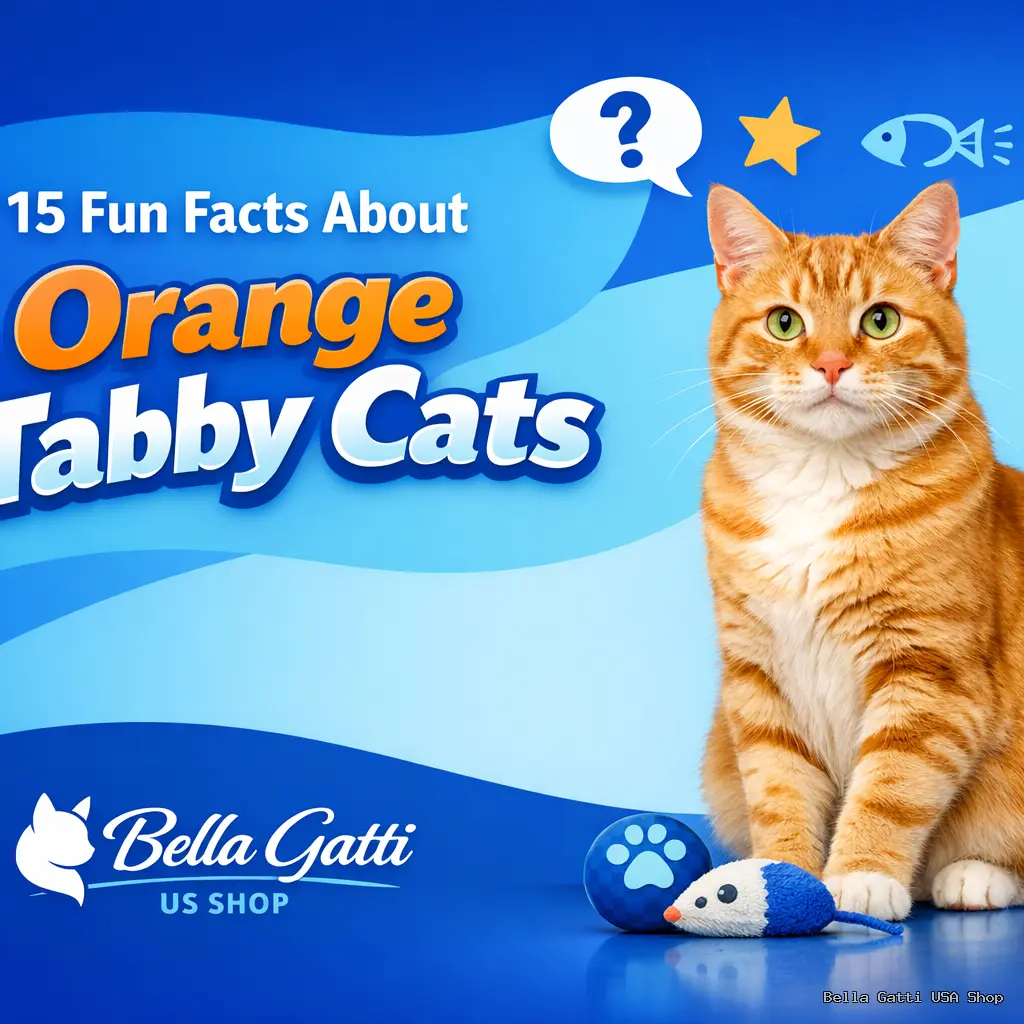
15 Fun Facts About the Iconic Orange Tabby Cat
- Not a Breed, Always a Tabby: The orange tabby is a coat pattern (not a breed) defined by the distinct ‘M’ on the forehead. Due to genetics (the Agouti gene), every single orange cat is technically a tabby cat.
- Overwhelmingly Male: The gene for the orange coat color (caused by pheomelanin) is sex-linked on the X chromosome, resulting in approximately 80% of all orange cats being male.
- Bold Personality: These “Ginger cats” are famous for being highly outgoing, vocal, and extremely affectionate, often earning the nickname “Velcro cats” due to their clingy nature.
- Pop Culture Icons: Orange tabbies are superstars in media and history, featuring prominently as the lazy, food-obsessed cartoon icon Garfield and as the cherished companion of historical figure Winston Churchill (Jock).
Table of Contents
- Fact 1: The Orange Tabby Cat is Not a Breed
- Fact 2: The Orange Tabby Cat is Overwhelmingly Male (80%!)
- Fact 3: Orange Cat Genetics: It’s All About Pheomelanin
- Fact 4: Why Every Orange Tabby Cat Has an ‘M’ on Its Forehead
- Fact 5: The Orange Tabby Coat Markings Were Named After Silk
- Fact 6: Every Orange Cat is a Tabby Cat (The Agouti Gene Rule)
- Fact 7: Stripes, Swirls, and Spots—The Four Tabby Patterns of the Orange Tabby Cat
- Fact 8: The Orange Coat Color Gene: ARHGAP36 and Pheomelanin
- Fact 9: They Are the Most Talkative Cats
- Fact 10: The Orange Tabby Cat Gets Charming Black Freckles
- Fact 11: Orange Tabby Cats Are Pop Culture Superstars
- Fact 12: Winston Churchill and His Beloved Ginger Companion
- Fact 13: Orange Tabby Cats Are Often “Velcro Cats”
- Fact 14: Keeping Your Ginger Cat Happy and Healthy
- Fact 15: Why the Orange Tabby Cat Is Everywhere
- The Ultimate Orange Tabby Cat Summary: Facts, Genetics, and Fame
- Frequently Asked Questions About Orange Cats and Ginger Genetics
- Conclusion
The orange tabby cat is basically feline sunshine. When you spot that bright, ginger fur, you know you are in for a seriously good time.
Often nicknamed Ginger cats or “Marmalade cats,” these furballs capture attention everywhere they go, demanding pets and maybe a snack.
But what exactly makes the Orange cats so special? We are diving deep into the Orange coat color genetics, history, and yes, the famous cartoon cats like Garfield.
You might think you know everything about these charismatic creatures, but their history and genetics hold some truly surprising Orange cat facts. Prepare to learn why most of them are Male orange tabby cats!
We’ve collected 15 fascinating Tabby cat facts covering everything from their unique stripe patterns to their surprising link to historical figures like Winston Churchill.
Fact 1: The Orange Tabby Cat is Not a Breed
Let’s kick off the Orange cat facts with the big one: the Orange tabby cat is not a specific breed. If you thought these fabulous furballs had their own pedigree, you might be surprised!
The term “tabby” describes the cat’s coat pattern (the signature stripes, swirls, or spots) not the cat’s actual lineage. It’s a description of their stylish Tabby coat markings.
This means your beloved Orange cats can belong to almost any existing breed. They are most commonly a Domestic Shorthair or Domestic Longhair.
However, you can find the Orange coat color on a Persian, a Maine Coon, or even an American Bobtail.
If the cat has the characteristic markings and that distinctive ‘M’ on the forehead, congratulations, it’s a tabby, regardless of its heritage.
Fact 2: The Orange Tabby Cat is Overwhelmingly Male (80%!)

If you are welcoming an Orange tabby kitten into your home, prepare for a boy. This is one of the most reliable Orange cat facts you’ll ever learn: roughly 80% of all Orange cats are male.
That means only about one in five is a Female orange tabby. It’s a massive gender imbalance that makes the rare female ginger cat a true feline unicorn!
This massive skew toward the Male orange tabby is all down to complex Orange cat genetics. The gene responsible for the Orange coat color (specifically the production of the *Pheomelanin pigment*) is carried exclusively on the X chromosome. This is known as a Sex-linked mutation.
Because males have only one X chromosome (XY), they only need one copy of the gene to display the vibrant Ginger fur. Females (XX) need the gene present on both X chromosomes to be a completely solid orange color.
This genetic reality explains why famously lazy or demanding Orange cats, like the iconic cartoon character Garfield, are always depicted as male. If you are looking for a clever, opinionated cat, you might be looking for a Male orange tabby.
Fact 3: Orange Cat Genetics: It’s All About Pheomelanin

The secret behind that stunning Orange coat color is a specific pigment called pheomelanin. If you have red hair yourself, you share the same color chemistry with your Orange tabby cat!
The intensity of this pigment determines the cat’s exact shade. You might see shades ranging from a pale cream to a deep, fiery reddish-orange, fitting for an iconic figure like Winston Churchill’s beloved ginger cat.
All cats naturally produce two pigments: pheomelanin (red/yellow) and eumelanin (black/brown). The Orange cat genetics are controlled by a powerful, sex-linked gene (O gene).
This O gene acts like a switch. It forces the cat’s body to produce only pheomelanin pigment, giving you that pure Ginger fur.
Because this color gene lives on the X chromosome, it directly influences why the vast majority (80%!) of these beautiful felines are Male orange tabby cats, making the study of Orange cat genetics endlessly fascinating.
Fact 4: Why Every Orange Tabby Cat Has an ‘M’ on Its Forehead

You can identify any Orange tabby cat instantly by the distinct ‘M’ marking right above their eyes. This is the tell-tale sign of all Tabby coat markings and a mandatory feature for every Ginger cat.
If you see an ‘M’, you are looking at a true tabby. This pattern is determined by the Agouti gene, which controls the banded color on individual hairs.
But the science is less fun than the legends! One famous tale claims that the ‘M’ was placed there by Mother Mary herself.
The story goes that a tabby cat kept Baby Jesus warm in the manger, and Mother Mary marked its forehead in gratitude for its service.
Another popular legend credits the Prophet Mohammed, who was said to have loved his cat so much he protected the sleeping animal.
Regardless of the origin, the ‘M’ ensures that no matter the specific shade of their Orange coat color, every Orange cat is instantly recognizable.
Fact 5: The Orange Tabby Coat Markings Were Named After Silk
You know the striking pattern on your favorite Orange tabby cat? That distinctive look has an exotic, ancient origin.
The term “tabby” itself comes from ‘Attabiya’, a district located in Baghdad, Iraq.
This specific area was famous for producing luxurious, striped silk fabric centuries ago.
Because the fabric’s design mirrored the natural stripes and swirls of the feline’s coat, the name was adopted into English.
This is why we still refer to these beautiful Ginger cats and their distinctive Tabby coat markings today.
Fact 6: Every Orange Cat is a Tabby Cat (The Agouti Gene Rule)

The iconic stripes and swirls that trace back to the luxurious silks of Baghdad? They are mandatory for all Orange cats. This is a critical piece of Orange cat genetics.
Due to the way the dominant Agouti gene interacts with the pigment responsible for the Orange coat color (called Pheomelanin), the striping pattern must always be expressed.
In short: it is scientifically impossible to have a truly Solid orange cat.
If you see an adult Orange tabby cat that appears to have uniform Ginger fur, look closer. They will always have faint “ghost stripes.”
These subtle Tabby coat markings are usually visible on their legs, tail, or forehead. They are always most prominent when the cat is a tiny Orange tabby kitten.
Whether they display the Mackerel tabby pattern or the swirled Classic tabby look, every single Ginger cat is, genetically speaking, a Tabby cat.
Fact 7: Stripes, Swirls, and Spots—The Four Tabby Patterns of the Orange Tabby Cat
We just learned that every single Orange cat is genetically a tabby, thanks to the dominant Agouti gene influencing their bright Ginger fur. But if you look closely at different Orange tabby cats, you’ll notice their specific Tabby coat markings aren’t all the same.
While the Agouti gene ensures the individual hairs are banded with color, other modifier genes dictate the final design of the pattern. These beautiful variations are what make the iconic Domestic Shorthair and Domestic Longhair Orange cats unique!
You can identify four main Tabby patterns:
-
- Mackerel Tabby: If your Orange cat looks like a mini jungle predator, you have a Mackerel pattern. These are the classic “tiger stripes,” narrow, vertical lines running consistently down the sides of the body.
-
- Classic Tabby: Also known as blotched or marbled. This pattern is characterized by thick, swirling bands. These Orange cats often have a distinctive “bull’s-eye” or target shape visible on their sides.
-
- Spotted Tabby: Think of the Spotted Tabby as a broken Mackerel pattern. Instead of continuous stripes, the markings appear as distinct spots scattered across the Ginger fur of the Orange tabby cat.
-
- Ticked Tabby: This pattern is the ultimate genetic trickster. While technically still a tabby (remember the Agouti gene rule!), the body appears sandy or salt-and-pepper. The stripes are only clearly visible on the face and legs, giving the appearance of an almost solid Orange coat color.
Fact 8: The Orange Coat Color Gene: ARHGAP36 and Pheomelanin
You love that bright, unmistakable Orange coat color of your Orange tabby cat. But what exactly makes the fur so wonderfully Ginger? Geneticists have spent decades zeroing in on this specific coloration, particularly the mysterious X chromosome influence on coat color.
Science finally delivered the definitive answer in 2024. Two major papers, an American study (2024) and a simultaneous Japanese study (2024), confirmed the long-held theories about Orange cat genetics.
These groundbreaking studies pinpointed the specific gene responsible for the vibrant orange expression: the ARHGAP36 gene. This gene essentially acts as the master switch, controlling the signaling pathway for pigment production.
This research confirmed that the Orange cats get their hue from the abundance of pheomelanin pigment (the same pigment responsible for red human hair).
As reported in Newsweek, the confirmation of the ARHGAP36 gene and the crucial X chromosome influence on coat color explains why the Female orange tabby is such a genetic rarity, a topic we’ll dive into next!
Fact 9: They Are the Most Talkative Cats
We just covered the deep science behind the Orange coat color. Now, let’s focus on the big personality that comes with that bright fur. Stereotypes about Orange tabby cats being loud mouths exist for a reason.
These Ginger cats are widely known for being incredibly vocal, chatty, and communicative. They use a massive range of sounds, from loud meows and demanding chirps to soft trills, to get your attention.
If you own an Orange cat, you know they are not shy about telling you exactly what they want. They are the ultimate conversationalists, making this one of the most beloved Tabby cat facts.
If you want a companion who is always ready for a chat, choose orange. They definitely let you know when the food bowl is empty, channeling their inner Garfield with demanding persistence.
Fact 10: The Orange Tabby Cat Gets Charming Black Freckles
We’ve covered the loud mouths of these magnificent Orange cats. Now, let’s talk about another unique trait of the aging Orange tabby cat: the development of tiny black spots.
Have you noticed little black dots appearing on your cat’s nose, lips, or gums? These are often referred to as Black freckles, and they are one of the most common Orange cat facts.
These freckles are extremely common in older Ginger cats. They are caused by a harmless condition called benign lentigo, which simply increases the number of pigment-producing cells in the skin.
This means your cat’s beautiful Cat pigment characteristics are maturing! These freckles are nothing to worry about and just add to the iconic charm of the mature Ginger fur.
Fact 11: Orange Tabby Cats Are Pop Culture Superstars
If you love Orange cat facts, you already know these Ginger cats are built for the spotlight. The Orange tabby cat is the quintessential cartoon feline, representing laziness, mischief, and deep, demanding affection.
You instantly recognize Garfield, perhaps the most famous Orange tabby cat in history. Known for his intense love of lasagna and extreme distaste for Mondays, Garfield perfectly embodies the witty, sometimes grumpy, stereotype associated with this Orange coat color.
These Tabby cat facts prove their celebrity status is well-earned. The list of famous ginger felines is long and varied, crossing genres from fantasy to sci-fi.
We see them everywhere: Crookshanks from the Harry Potter series, Milo from the major motion picture adventure, and even Jones from the movie Alien.
Another iconic star is Orangey, the talented and notoriously difficult Orange cat who appeared in films like Breakfast at Tiffany’s, cementing the Orange tabby cat’s place in Hollywood history.
Fact 12: Winston Churchill and His Beloved Ginger Companion
If you thought the fame of the Orange tabby cat was limited to pop culture superstars like Garfield, think again. Even powerful historical figures fell hard for the charisma of these Ginger cats.
Winston Churchill, the iconic British Prime Minister, was famously devoted to his feline friend, Jock. This particular Male orange tabby was more than just a pet, he was a constant companion.
Jock, known for his striking orange coat color, reportedly had full run of Churchill’s country home, Chartwell, confirming that the best cats always run the house.
Churchill loved Jock so much that he requested in his will that there must always be a cat named Jock residing at Chartwell, ensuring the legacy of the quintessential Orange tabby cat continued for generations.
That is one impressive piece of Orange cat facts history, proving their magnetic appeal spans centuries.
Fact 13: Orange Tabby Cats Are Often “Velcro Cats”
The Orange tabby cat isn’t just known for its striking Ginger fur and bold Tabby coat markings, it is famous for its exceptionally friendly temperament.
These Orange cats are often far less reserved than other coat colors, making them excellent companions.
They earned the nickname “Velcro cats” because they stick close to their humans, seeking out laps and shoulders for prime cuddling opportunities.
If you are looking for a feline friend who demands attention and constantly thinks it is a dog, the Male orange tabby is likely your best bet for affectionate, constant company.
Just like famous attention-seekers such as Garfield, these cats thrive when they are the center of your universe.
Fact 14: Keeping Your Ginger Cat Happy and Healthy
Your playful Orange tabby kitten or dignified adult Orange tabby cat needs a clean, stimulating home to truly thrive. Quality care is paramount, especially for these famously friendly Ginger cats.
Since Orange cats are such loyal companions, owners appreciate modern solutions that keep their space pristine. Advanced systems, like the Litter-Robot 4, help manage waste automatically, ensuring a spotless environment for your beloved pet.
Tracking your Orange tabby cat’s health is easier than ever. The associated Whisker app allows you to monitor litter habits and overall wellness right from your phone, giving you peace of mind that your friendly Tabby cat is well cared for.
Fact 15: Why the Orange Tabby Cat Is Everywhere
You’ve learned about the genetics, the charm, and the quirks of the Orange tabby cat. Now for the final fact: These joyful furballs are incredibly common!
The ubiquity of the Orange coat color is because the tabby pattern is not restricted to a single pedigree Cat breed. It is found across the massive population of mixed-breed cats.
The majority of these friendly Ginger cats fall under the Domestic Shorthair category. Since the Domestic Shorthair is the most common cat in the US, this ensures the Orange tabby cat remains one of the most recognizable and beloved types of cats globally.
Whether they remind you of the famous cartoon cat Garfield or a dignified figure like Winston Churchill’s favorite feline, these Orange cats have truly secured their spot as America’s favorite house cat.
The Ultimate Orange Tabby Cat Summary: Facts, Genetics, and Fame
You’ve absorbed 15 facts about the magnificent Orange tabby cat. Before you head off to find the perfect Ginger cats T-shirt, here is the ultimate cheat sheet, a quick breakdown of the most crucial facts about their unique characteristics and unmistakable Orange coat color.
These Orange cats are defined by fascinating genetics and a history that stretches back to ancient Baghdad.
| Characteristic | Description | Scientific Basis |
|---|---|---|
| Gender Skew | Approximately 80% of all Orange cats are male. The Female orange tabby is a genetic rarity. | Caused by the O gene, which dictates the Orange coat color and is a Sex-linked mutation residing on the X chromosome. |
| Pigment Source | The fiery Ginger fur is derived entirely from red/yellow pigment. | Driven by high levels of Pheomelanin production. |
| Marking Origin | The word ‘tabby’ relates to the striped silk pattern first created in the Middle East. | Named after the ‘Attabiya’ district in Baghdad. |
| Pattern Requirement | All true Orange tabby cats must display stripes, dots, or whorls. There is no such thing as a truly Solid orange cat. | Interaction between the dominant O gene and the Agouti gene, which controls the visibility of the stripes and other Tabby coat markings. |
| Age Markers | Older Orange cats often develop small black spots on their nose, lips, or paws. | Benign lentigo (harmless Black freckles). |
| Famous Examples | Frequently represented in popular culture as mischievous, loyal, or food-obsessed icons. | Examples include the cartoon icon Garfield, the magical familiar Crookshanks, and Winston Churchill’s beloved Jock. |
Frequently Asked Questions About Orange Cats and Ginger Genetics
Still curious about the magnificent world of Orange tabby cats? We get it. These Ginger cats inspire devotion (and a lot of great graphic tees). Here are the most frequently asked questions about their unique characteristics and unmistakable Orange coat color.
Is a Solid Orange Cat Really a Tabby?
Absolutely yes. All cats displaying the Orange coat color gene are genetically tabbies. This is because the orange gene (which produces the Pheomelanin pigment) actually requires the presence of the non-solid coat pattern, controlled by the Agouti gene, to fully express.
Even if a cat looks like a Solid orange cat, they will have faint stripes, often called “ghost stripes.” These Tabby coat markings are usually visible when they are an Orange tabby kitten or under specific lighting conditions.
Why is the Female Orange Tabby so Rare?
This is all down to fascinating Orange cat genetics and a classic example of a Sex-linked mutation. The gene responsible for the Orange coat color is carried directly on the X chromosome.
Because females have two X chromosomes (XX), they need the orange gene on both to be fully orange. Males (XY) only need one copy.
This simple genetic fact means that the Male orange tabby is roughly four times more common than the Female orange tabby. If you encounter one, you have spotted a true rarity!
What are the Most Common Cat Breeds for Orange Tabbies?
The term “tabby” describes a pattern, not a breed. Therefore, the orange coat can appear across many different Cat breeds.
The vast majority of Orange cats are mixed breeds, specifically the beloved Domestic Shorthair (DSH) and Domestic Longhair (DLH). These are your classic neighborhood Ginger cats.
However, you will also see the orange coat expressed in purebreds, often displaying various Tabby patterns like the Mackerel tabby or Classic tabby, in breeds such as the Maine Coon, Persian, and American Bobtail.
Do Orange Tabby Cats Have a Unique Personality?
While every cat is an individual, the answer is a resounding “Yes!” Anecdotal evidence, supported by some studies, suggests Orange cats are often the most outgoing, friendly, and even demanding felines.
They are frequently described as bold, talkative, and having a relaxed, dog-like temperament, a perfect fit for the lazy, lasagna-loving character of Garfield or the adventurous spirit of Milo.
This perceived personality link is one of the most endearing Tabby cat facts and why their Ginger fur is so popular for apparel designs.
What is the Average Lifespan of an Orange Tabby Cat?
The Orange coat color does not influence longevity. The lifespan of your Orange tabby cat depends entirely on its breed, genetics, and lifestyle.
Since most are hardy mixed breeds like the Domestic Shorthair or Domestic Longhair, they typically enjoy a healthy life of 12 to 15 years, and often much longer.
With excellent veterinary care, proper nutrition, and modern conveniences like the self-cleaning Litter-Robot, many of these beloved Ginger cats easily surpass the 15-year mark.
Conclusion
The Orange tabby cat is truly iconic. More than just a pretty face with that distinctive “M” on the forehead, these vibrant creatures represent a fascinating intersection of complex Orange cat genetics, ancient history tracing back to Baghdad, and undeniable star quality.
We learned why the Male orange tabby is so common and why a Female orange tabby is a rare, beautiful phenomenon governed by the X chromosome influence on coat color.
Armed with these Tabby cat facts, you can now impress fellow cat lovers with knowledge about their unique Orange coat color, their bold personalities, and their connection to historical figures like Winston Churchill and pop culture legends like Garfield.
Whether you are cuddling a rare Female orange tabby or a vocal Male orange tabby, you are hosting a piece of feline history coated in beautiful Ginger fur.
Ready to show off your dedication to the ginger life? We celebrate these bold, beautiful Orange cats with our line of witty, soft-cotton graphic tees. Find the perfect design that captures the charm of your own Orange tabby cat and share these amazing Orange cat facts with the world.